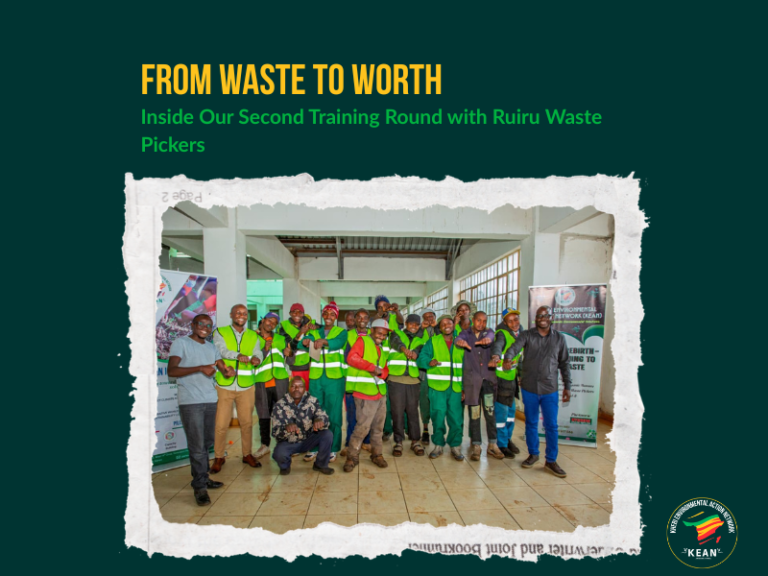


Inside KEAN’s Composting Demonstration in Ruiru
“Sixty tonnes of organic waste. Two communities. One powerful demonstration of what happens when waste pickers and farmers build something together.”
In Githurai and Ruiru markets, organic waste arrives every day in enormous quantities — vegetable trimmings, fruit peels, eggshells, and green matter piling up with nowhere meaningful to go. For most, it’s simply refuse. For the Organic Rebirth Project, it’s raw material.
Last month, KEAN International, in collaboration with Hygrow Fertilizer, brought together waste pickers and smallholder farmers from Kiambu County for a hands-on composting demonstration — not a lecture, not a slideshow, but a full, practical build of a compost heap from the ground up.
| 60T Organic waste collected from Githurai & Ruiru markets | 58–65°C Target internal temperature for effective decomposition | 60% Potential reduction in waste volume through composting |
Composting is a science, not a shortcut
The session was led by agronomist Teresia Wairimu of Hygrow Fertilizer, whose first act was deceptively simple: dig a pit 30 centimetres deep, and set the topsoil carefully to one side. That topsoil — rich in the microorganisms that drive decomposition — would return at the very end.
What followed was a methodical, layered approach that reflects the core logic of composting: balance between carbon, nitrogen, oxygen, and moisture.
HOW THE COMPOST HEAP IS BUILT, LAYER BY LAYER
| Layer | Material | Purpose |
| 1 | Straws & twigs | Rough dry material that creates air pockets — microorganisms need oxygen to survive and break matter down |
| 2 | Dry leaves | High in carbon, the primary energy source for decomposition |
| 3 | Manure | Nitrogen-rich, activates microbial breakdown and adds nutrients to the final product |
| 4 | Eggshells | A calcium and mineral boost that enriches the final compost composition |
| 5 | Kitchen waste & green matter | Supplies nitrogen and moisture, accelerating the overall decomposition process |
| 6 | Wood ash | Adds potassium and helps neutralize soil pH for healthier growing conditions |
Each six-layer sequence constitutes one “course.” An effective heap requires a minimum of five courses — built to a height that allows proper aeration, moisture control, and regular monitoring. After each course, approximately 60 liters of water are sprinkled in to activate microbial activity. The heap must be moist, not waterlogged.
Reading the heap: temperature as a diagnostic tool
One of the most practical skills demonstrated was heap monitoring — and participants didn’t need expensive equipment to do it. A standard thermometer should read 58–65°C inside an active heap — hot enough to kill pathogens and weed seeds. Without a thermometer, a long dry stick tells the same story:
- Warm stick: active decomposition underway
- Dry or white stick: too hot — add water
- Cold stick: low activity — turn or moisten the heap
The heap is turned every 21 days — three times in total. Turning introduces fresh oxygen, redistributes materials, and dramatically accelerates breakdown. Once complete, the heap is covered with the original topsoil and dry materials to retain moisture, prevent nutrient loss, and protect it from rain and direct sun.
| “After the first demonstration, waste pickers and farmers took the lead. Each layer was built collaboratively — knowledge shared, adapted, and owned.” |
The moment the training became something else
The most significant moment of the day didn’t come from an instructor. After Teresia demonstrated the first course, the participants moved in. Waste pickers and farmers worked side by side, each layer built through shared hands and shared knowledge. The agronomist stepped back. The community stepped forward.
That’s not a small thing. Community-led learning of this kind tends to outlast any single training session — it travels, it replicates, and it creates the kind of ownership that formal programmes rarely achieve.
By the end of the demonstration, participants had committed to starting their own compost heaps, sharing what they’d learned within their networks, and actively promoting sustainable farming practices in their communities.
Why compost matters beyond the farm
Finished compost does more than feed crops. One kilogram of humus holds up to six liters of water — critical for smallholder farmers managing rain-fed agriculture in a changing climate. It improves soil structure regardless of soil type, binding sandy soils and loosening clay. It supplies nutrients slowly and consistently, reducing reliance on costly synthetic fertilizers. And because the heap reaches temperatures of up to 60°C during decomposition, it eliminates many of the pathogens and weed seeds that would otherwise re-enter the growing system.
For communities like those in Ruiru and Githurai, the circular logic is clear: the markets that once produced a waste problem now produce the solution to it.
This is KEAN’s Organic Rebirth Project — a decentralised composting initiative rooted in Kiambu County, Kenya, focused on waste picker rights, community empowerment, and regenerative soil health. From market to farm. From waste to wealth. |