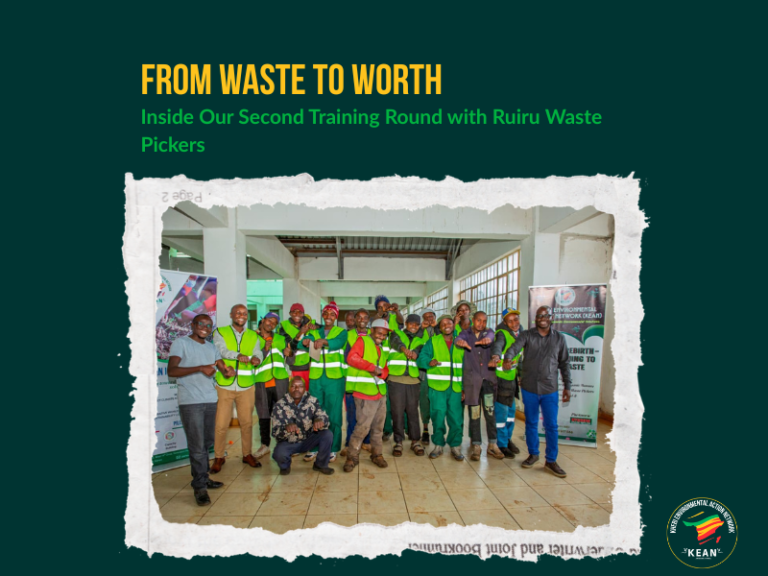


What does justice look like at the edge of a dumpsite? For KEAN International, it looks like a circle of waste pickers in Ruiru, Kenya; learning, equipped, and finally recognized for the essential environmental work they have always done.
In a landmark first step, KEAN International convened informal waste pickers in Ruiru for the inaugural training session of the Organic Rebirth Project, a transformative initiative addressing the intersection of waste management, soil restoration, and worker rights. The session focused on decentralized composting and rights-based inclusion, setting the tone for a program that refuses to separate technical solutions from the dignity of the people who deliver them.

A Systems Failure, Not a Waste Problem
KEAN International’s Programs Director, Kelvin Bidanya, opened the training with a reframing that anchors the entire project:
“Organic waste forms nearly 80% of the waste generated in urban areas, yet most of it ends up in dumpsites. This is not a waste problem it is a systems failure.”
— Kelvin Bidanya, Programs Director, KEAN International

This framing is central to everything Organic Rebirth does. Organic waste is not an inconvenience to be disposed of, it is a resource being squandered at immense social, environmental, and economic cost. The project is designed to plug this gap by establishing decentralized composting facilities, equipping waste pickers with technical composting skills, and embedding dignity and recognition into every stage of Kenya’s zero-waste transition.
Re-framing Compost as a Market Product
The training’s technical session was led by Teresia Wairimu, an Agronomist with Organic Fields, who brought clarity and practical depth to the science of composting. She walked participants through the full composting lifecycle, from the building blocks of quality compost, to the critical role of laboratory testing, moisture and dryness balance, curing, quality control, and essential safety and hygiene practices including correct PPE use.

Critically, Teresia re-framed compost not as the end of a waste chain, but as the beginning of a market opportunity. Organic compost commands real value as a product, with clear linkages to:
- Farmers seeking soil-enriching alternatives to synthetic inputs
- Schools and institutions managing green spaces
- Tree nurseries and urban agriculture enterprises
The session also explored value addition through packaging and granulation, and the importance of branding in improving organic waste uptake in a market currently saturated with synthetic alternatives.
Why Organic Fertilizer Wins
Kenya’s fertilizer market is currently dominated by synthetic inputs. Yet the case for organic fertilizer is scientifically compelling and economically sound:
- Slow, sustained nutrient release that nourishes plants over time
- Feeds the soil ecosystem before it feeds the plant
- Improves long-term soil structure and fertility
- Delivers a broader nutrient diversity than synthetic alternatives
- More economical over a full growing season
- Better delivery mechanisms and absorption rates
Synthetic fertilizers, by contrast, typically supply only phosphorus, nitrogen, and potassium, a fraction of what a healthy soil ecosystem requires. With 80% of our urban waste stream already organic, the question is not whether Kenya can produce world-class compost. It can. The barriers are policy, licensing burdens, and a narrative gap that this project is working to close.
If 80% of our waste stream is organic, why are we importing soil solutions?

Structural Challenges That Must Be Addressed
The training did not shy away from the systemic obstacles facing organic waste entrepreneurs and workers. Two structural barriers were identified as particularly acute:
Licensing overload: Organic fertilizer producers face multiple, overlapping licensing requirements to ensure compliance, a bureaucratic burden that disproportionately disadvantages small-scale producers and worker cooperatives.
Insufficient county-level support: Despite solving a pressing public waste crisis, organic composting enterprises receive limited facilitation from county governments, even as those same governments struggle with overburdened landfills and dumpsites.
These are not inevitable features of the landscape. They are policy choices and policy choices can be changed.
The Rights of Waste Workers: A Legal Foundation
Organic Rebirth is not simply a composting program. It is a rights-based intervention. The training made explicit what the law already guarantees, and what practice routinely denies.
Waste pickers are environmental workers. They are climate actors. They are soil re-generators.

Under the Constitution of Kenya, Articles 42 and 43 guarantee every person the right to a clean and healthy environment, human dignity, social security, and decent working conditions. Articles 69 and 70 impose direct obligations on the state to manage the environment sustainably and enforce related rights, including protection of waste workers from hazardous conditions.
The Sustainable Waste Management Act of 2022 further reinforces this framework, calling for a transition from linear, open-dumping models to circular economies that formally recognize and value waste workers’ roles in segregation, collection, and recycling.
The law is clear. The challenge is implementation and that is where Organic Rebirth intervenes.
Organization as Power
One of the training’s most powerful insights was this: waste pickers working without formal structures lack collective voice, and without voice, they are excluded from the policy spaces that shape their working conditions and livelihoods.
When organized into formal groups, waste workers can:
- Participate meaningfully in public participation forums
- Influence County Integrated Development Plans (CIDPs)
- Advocate collectively for decent wages and PPE provision
- Push for social security mechanisms tailored to the occupational risks they face
Organic Rebirth is supporting waste pickers to make this transition from isolated individuals to organized, visible, and politically engaged workers.

More Than Training: Equipping with Dignity
KEAN International did not stop at knowledge transfer. Participants were equipped with protective gear a concrete act that carries symbolic weight far beyond its practical value.
“We handle waste, and in that handling, we feature nowhere.”
— A participant, Organic Rebirth Training, Ruiru
Organic Rebirth ensures they feature visibly and structurally. Dignity is not charity. It is recognition.
Working at the Intersection
Organic Rebirth is deliberately designed to operate where multiple crises converge. This is not a single-issue initiative:
- Waste reduction, diverting organic material from dumpsites
- Soil restoration, rebuilding depleted farmland with compost
- Informal worker inclusion, formalizing and recognizing the labor of waste pickers
- Market linkage development, connecting producers to buyers and creating sustainable income streams
This is climate mitigation. This is food security. This is a just transition.
What Comes Next
The Ruiru launch is the first in a series of Organic Rebirth training and mobilization sessions. KEAN International will continue to expand the program’s footprint, deepen worker organization, establish decentralized composting facilities, and advocate for the policy reforms needed to unlock the full potential of Kenya’s organic waste stream.
Follow our progress using #OrganicRebirth, and join us in building a waste system that is circular, just, and human.